

As the latest Critical Role season gains momentum, leading up to the final episode of its introductory phase and dividing the players into three separate groups, audiences are continuing to learn more about the enigmatic realm of Aramán, designed by Dungeon Master Brennan Lee Mulligan. Exandria, the world of past seasons, drew extensively from established D&D lore. In contrast, one of the most exciting aspects of Campaign 4 is how Mulligan reinterprets those familiar references to create something truly original.
A Fresh Perspective on Angelic and Fiendish Beings
Viewers have already been introduced to Aramán’s melancholy and warped interpretation of the Celestials, but the third installment, titled “The Snipping of Shears,” also delivers some background about their fiendish counterpart, the demons. This term has been used somewhat broadly in the current season, but the intriguing part is that it also includes characters that would be categorized as “tieflings” in traditional Dungeons & Dragons worlds, such as the demon warlock Tyranny, portrayed by Whitney Moore.
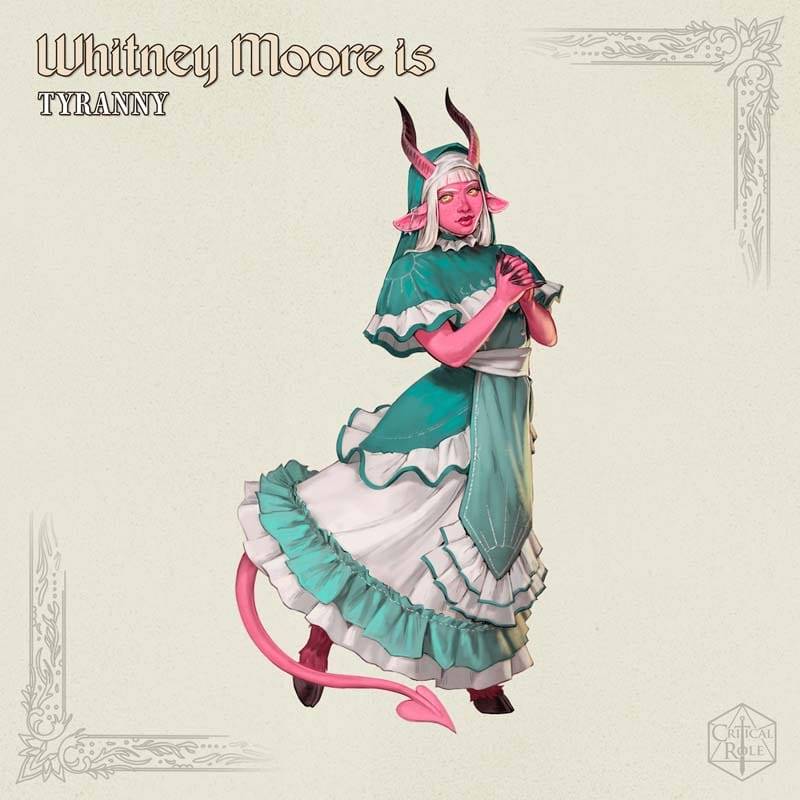
Traditionally, the fiend-touched race are humanoids with infernal heritage, but it seems that in Aramán, they’re true demons whose souls have come to inhabit a mortal body as the outcome of a deal. In the latest episode, we learned that demons reside in a place called the Pit, governed by an ominous being called the Shadow of Suffering. This powerful figure made an agreement with a noble family, in which he would provide them with demons to use as servants and as examples of salvation for the Candescent Creed. As payment, he would receive mortal souls and some of the Filament, a substance with divine properties produced by the the family.
Deciphering the Fresh Mythology
If you find all this puzzling, you’re not alone. Mulligan is a master of teasing, and he’s being very careful about how much he reveals in each episode. Nevertheless, we can assume from what we know that Aramán’s tieflings are infernal spirits who occupy a physical form. This is a nice spin on one popular D&D character species, and one with the potential to make it more engaging.
The Origins of The Fiend-Touched
The beginning of this race dates back to 1994 and the famous Planescape Campaign Setting for advanced Dungeons & Dragons. They were loosely defined as humans with extraplanar ancestry, implying it originated from devils, demons, or other malevolent entities. Planescape author Zeb Cook revealed in a later interview that he left the tieflings' origins vague on purposefully because he aimed to create an character type for a redeemed fiend/antihero character, in part to appeal to the dark and emotional subcultures. Later versions of D&D, however, clarified and restricted those origins (a choice that Cook disapproved of), leading to the widely accepted view that tieflings all have lineage that traces back to the infernal dimensions.

While the details about that ancestry differ a lot, the common point is that these characters are humans with the blood of Fiends running through their veins. In the game, infernal creatures are the inhabitants of the Lower Planes of malevolent nature, including the the chaotic void, the the infernal realm, Carceri, the fiery pit, Pandemonium, and probably a few more that are often overlooked. This universe structure is shared among almost all fantasy worlds, including the previous campaign setting, which has had its fair share of demonic encounters. Although these evil creatures are native to the infernal realms, they can be called forth to the Material Plane or enter it through gateways. They come through with their physical bodies, but they can only be truly slain on their native planes.
Breaking with Convention
The description of the infernal domain and its denizens made in episode 3 of Campaign 4 deviates from these standard features. The High Prince strongly resembles the archdevil, the ruler of the Nine Hells, with all that scheming and soul bargaining, but it seems is that the demons of Aramán lack a true physical body, or at least one they can use to access the “Material Plane” (or whatever its name is in the setting). Tyranny specifically says in that episode that she was “given a body” just six months ago, and before that she was just a “swirling soul” in the infernal abyss, so this seems to be the beginnings of the fiend-touched in Aramán (upcoming installments may show traditional tieflings actually exist, but given that Tyranny is a player character, this is improbable).
The Original Vision
Going back to the designer’s comments, he explained that he created tieflings to fill a particular niche: the cursed, quasi-damned protagonist, that didn’t exist in the game’s high fantasy character lineup at the time. Planescape co-writer Colin McComb said in the same interview that "These characters appeal because they're dark and edgy. They've got an inherent mystery. They're outsiders and loners, and they have a good reason to shun society (and be rejected by them).” Over the years, though, the darkness that was integral to the background of this race got diluted, and they simply became a highly favored playable race with additional magical abilities and a striking, unique appearance.
Returning to the Edge
This is perfectly fine. You can portray a cheerful fiend-blooded character who never contemplates about their fiendish bloodline, if that suits your style. Nevertheless, I think that Brennan Lee Mulligan’s version excels exactly because it doubles down on that “evil” origin, turning it into a core aspect of the persona. In every way, these demonic characters have a form only because of Ksha'aravi’s dealings with the Halovars. When she has the inevitable emancipation arc, freeing herself from the chains of her demonic brethren, it will seem impactful and intense because her race’s background is baked into the setting’s lore.
Looking Ahead
Besides this interesting new look at tieflings, I’m also curious to learn more about the infernal realm and this world’s fiends. Fans are enthusiasts for D&D’s cosmology, particularly the lore of the Lower Planes. One could study about strife in the Nine Hells, chaotic battles between Demon Lords, and the mysterious origins of the yugoloth endlessly. Yet, this lore is fairly uniform in every D&D setting, so there is anticipation for some new, meaningful addition to it.


